Structural Drying in Mooresville, NC
Structural drying is the part of the job that decides whether water damage comes back as warped floors or mold. The drying team dries framing, subfloor and walls to measured readings, not to a date on the calendar.
(888) 578-4720Get the structure dried to readings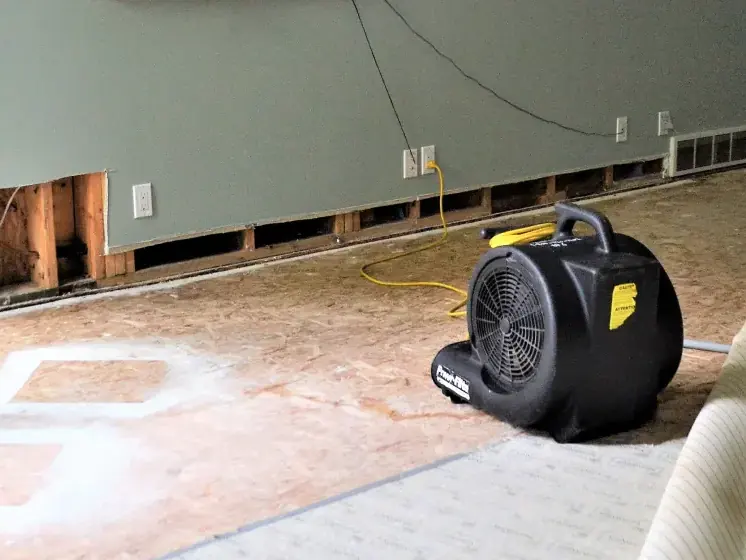
How structural drying is handled in Mooresville, NC
Map and classify
Moisture is mapped and the loss is classed from 1 to 4.
Set equipment
Air movers and dehumidifiers are sized to each room.
Monitor daily
Readings and psychrometric data are logged every day.
Verify dry
Equipment comes out when materials reach the drying goal.
What to do first about structural drying in Mooresville
- Stop the water source
Drying cannot start while water is still coming in.
- Remove standing water
Extraction always comes before drying.
- Keep windows closed in humid weather
Outside summer air usually adds moisture.
- Run the air conditioner if it is working
It helps pull humidity out of the house.
- Call for moisture mapping
A drying plan starts with knowing what is wet.
What does structural drying cost in Mooresville, NC?
In Mooresville, NC, structural drying typically runs $1,000 to $6,500, depending on the class of the loss, the number of rooms and how many days the equipment has to run.
One or two rooms
- Air movers and one dehumidifier
- Three to four days
- Daily readings
Several rooms or a crawl space
- Several dehumidifiers
- Cavity drying
- Drying log
Hardwood or Class 4 materials
- Desiccant dehumidifiers
- Floor mat systems
- Extended monitoring
These are typical ranges, not a quote. The drivers are the water category, the square footage, the material class and how fast drying started. For a closer planning number, try the water damage cost calculator.
Surface drying makes a room look dry. Structural drying makes it actually dry: the studs, the bottom plates, the subfloor, the joists in the crawl space and the underside of the hardwood. In Mooresville the challenge is the air itself. Summer humidity near Lake Norman is high, so drying depends on dehumidifiers that control the air inside the house, not on open windows.
How a drying plan is built
The tech who does the walkthrough maps moisture with pinless meters, pin meters and thermal imaging. The drying team then classifies the loss from Class 1, a small area with little absorbed water, to Class 4, dense materials like hardwood, plaster and concrete that hold water deep inside. The class sets how many air movers and dehumidifiers each room needs.
- Air movers set to the evaporation load of each room
- LGR dehumidifiers to pull the moisture out of the air
- Desiccant dehumidifiers for Class 4 materials and cool crawl spaces
- Floor mats and wall cavity systems for hardwood and closed walls
- Daily psychrometric readings and material readings in a drying log
How the drying goal is set
The drying team takes a reading on a dry reference material of the same kind in an unaffected part of the house. Wet materials are dry when they read within 2 to 4 points of that reference. Equipment is added, moved or removed based on the daily readings, and it comes out only when the goal is met.
Trade fact: in humid weather, running the home air conditioner during drying helps, while opening windows and crawl space vents usually slows the job.
Why the log matters
The daily drying log shows the adjuster exactly how the structure was dried and when it reached the goal. The EPA explains why materials need to dry inside the 24 to 48 hour window, and NC State Extension covers humidity control in North Carolina homes. For the space under the house, see crawl space water damage.
Structural Drying and Dehumidification questions in Mooresville, NC
What is the difference between surface and structural drying?
Surface drying makes a room look dry. Structural drying dries the framing, subfloor and wall cavities to measured readings, which is what prevents warping and mold.
How do you know when it is dry?
Wet materials are compared to a dry reference material of the same kind. When they read within 2 to 4 points of it, the drying goal is met.
Why not just open the windows?
In humid Mooresville weather, outside air often carries more moisture than the air inside. Dehumidifiers control the air far better.
What is an LGR dehumidifier?
A low grain refrigerant dehumidifier pulls more water out of the air than a household unit, especially as the air gets drier near the end of a job.
When are desiccant dehumidifiers used?
For dense Class 4 materials like hardwood and plaster, and in cool spaces like crawl spaces in spring and fall where refrigerant units work less efficiently.
How long does structural drying take?
Most losses dry in three to five days. Hardwood, plaster and concrete take longer, and equipment stays until the readings reach the goal.
Structural drying across Mooresville, NC
The Mooresville restoration crew handles structural drying downtown, in the Mill Village, along Brawley School Road and The Point, Williamson Road, Langtree and Mount Mourne, ZIP codes 28115 and 28117, with Troutman, Statesville, Davidson, Cornelius, Huntersville, Denver, Sherrills Ford and Kannapolis close by.
Water damage in Mooresville right now?
The restoration team extracts standing water, dries the structure to the IICRC S500 standard and documents every step for your insurance claim.